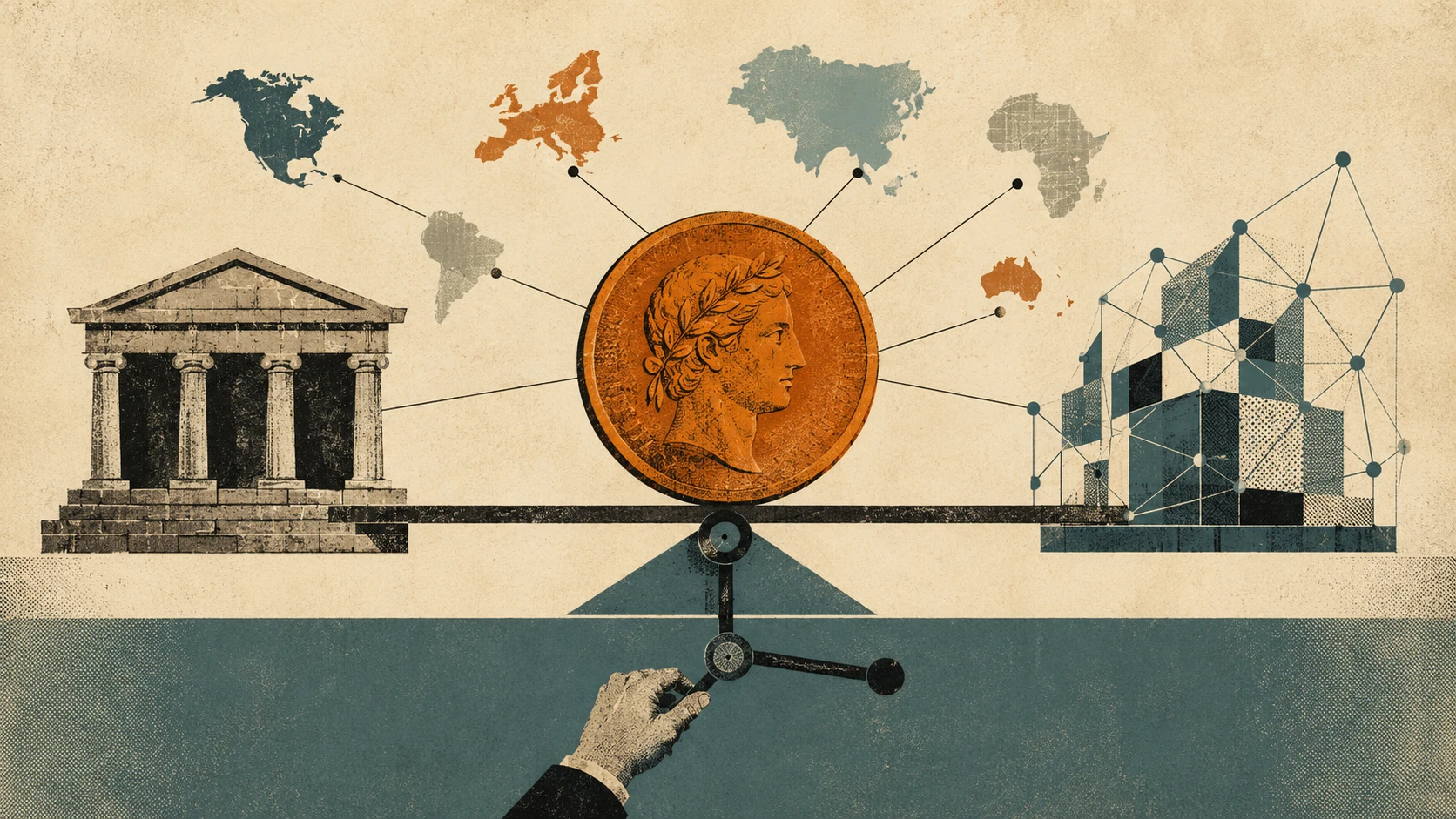
Economic historian Maylis Avaro discusses stablecoins, the digital euro and how dependence on currencies and payment systems can create political and economic vulnerability.
This interview with economic historian Maylis Avaro was originally broadcast on Near FM on 18 May 2026 as part of the radio show Do You Speak Tech?. The following is the full transcription of the conversation, exploring stablecoins, central bank digital currencies, monetary sovereignty and the historical relationship between money, trust and political power. The transcript has been lightly adapted for readability by adjusting punctuation and removing filler words, without altering the meaning of the conversation.
Patrick: Dr. Avaro, thanks for joining us today. Do you speak tech?
Maylis Avaro: Thank you for having me. It’s a great pleasure to be here.
Digital Money is new, but Money is not
Patrick: Oh, thanks to you. So, I have a lot of questions because I think this is a kind of trend topic and I’m glad that you accepted the invitation because we’ll ask you a few questions to help us to understand a bit more about this kind of new world, let’s call it, in this way.
In fact, my first question is when we hear terms like digital currency, stable coin or CBDC, we often think that this is just a new phenomenon and that’s it. But I think from an economic historian perspective there are already some parallelisms, probably, or those are completely new questions?
Maylis Avaro: I think that when we think about the digital world, we tend to see it as a completely new material revolution. Of course, online payments are something new in technological terms. But if we come back to the basic question: what is a stablecoin, or what is a CBDC? First and foremost, it is money.
And money is probably as old as exchanges between humans, from the Middle Ages and perhaps even before that.
So, we first need to remember that this is just a new evolution in the forms of money used to pay and to carry out transactions between individuals or firms.
When we think about CBDCs and stablecoins, another important dimension is the idea of a stabilized, or very stable, asset. In other words, its price should not change much over time.
But this is not really new either. If you think about the gold standard era, or even earlier periods when currencies were pegged to sterling, those were also times when the value of money did not change very much over time, or at least was designed to remain relatively stable.
So, the real novelty of these instruments is not simply that they are money, or that they aim to be stable. The novelty is that they exist in digital form.
Digital Currencies, Stablecoins and CBDCs explained
Patrick: Maybe let’s take a step back because we probably need a simple explanation of digital currency, stable coin, CBDC, cryptocurrency, etc… Just a brief overview of every single term let’s start with digital currency for example
Maylis Avaro: Yeah. So, digital currency is one of the broadest terms we have here. It simply means a currency that circulates digitally.
In a sense, we already use forms of digital currency. For example, if you pay with Revolut on your phone, that is a kind of digital payment, because you are moving money digitally.
When we speak about stablecoins or CBDCs, which stands for Central Bank Digital Currencies, we are talking about different instruments.
Stablecoins typically refer to forms of money or currency that exist on a blockchain: a type of digital infrastructure where transactions are recorded using cryptographic techniques. Stablecoins are usually tokens, or online assets, that are pegged one-to-one to an existing currency.
An example of a stablecoin today is Tether, or USDT, which is pegged one-to-one to the US dollar. So, in theory, the price of this token circulating on the blockchain should always be one US dollar.
A CBDC takes some of this digital payment innovation and brings it into the world of central banking. The idea is that a central bank, such as the European Central Bank or the Federal Reserve, could issue its own digital currency.
The difference is that Tether, which I mentioned before, is private money. It is issued and managed by a private company. A CBDC, by contrast, would be public money issued by a central bank.
What makes money trustworthy?
Patrick: Okay, thanks. I think that what they have in common is trust probably. And what does history tell us about what makes money trusted? Is it a matter of technology, institution, governance, political power or simply a combination of these factors?
Maylis Avaro: I think this is a very interesting question. I would say that you need a combination of all these factors for money to be widely accepted.
You cannot isolate just one of them and assume that it will work on its own. For example, you may have very strong technology and a very smart payment infrastructure. But if you do not have a trustworthy firm managing that infrastructure, or a regulator that can support or oversee that firm in case of default, a run on deposits, or panic in the market, then people will be reluctant to trust the technology.
They may fear that the right institutions, or the right public backing, are not there.
And vice versa: you may have a very large public institution issuing money, but if the payment infrastructure is slow or badly designed, or if there is a lot of inflation in the national currency, then public backing alone is not enough. If governance is poor and the technology is weak, people may also tend to avoid that currency.
Here, we can think, for example, of Argentina over recent decades. The Argentinian peso has experienced high inflation, and payments have often been difficult. As a result, people have turned towards other forms of money, such as the US dollar, in search of a currency with a better combination of technology, institutional credibility, and governance.
And finally, political power is also very important. When a currency circulates abroad, it also projects the power of the country or institution behind it.
What the Bank of Amsterdam can teach us about Stablecoins
Patrick: I think it’s very important what you said. People tend to avoid unstable currency. And I don’t remember when someone invented this invention called money. A long time ago, I guess. And I think there’s an interesting fact from the past that maybe you can help us to navigate. I’m talking about the bank of Amsterdam that is described like an early experiment, an early form of stable coin. What makes this historical example interesting and what those experiences teach us today about the stable coins. So, what can we learn from the past if this is like a good example?
Maylis Avaro: Yeah. So, the Bank of Amsterdam is a very interesting historical episode. It is often credited as probably the first proto-central bank in history, in the sense that it was a bank that managed to design a very efficient payment solution: a form of money that was widely adopted at the time.
What the Bank of Amsterdam did was quite innovative. At the time, people were paying with silver coins, but the problem was that these coins were often being tampered with. People would scrape off some of the precious silver content, so there were many different types of coins circulating, each with different levels of silver content. As a result, people had trust issues with these coins, because they were not all comparable in terms of their precious metal value.
The Bank of Amsterdam accepted silver coins as deposits. These coins were evaluated according to their true silver content, and in exchange, the bank credited people with what was then called the Guilder Banco. This bank guilder was a kind of bank deposit. Many merchants, banks, and correspondents in Amsterdam opened accounts at the Bank of Amsterdam, and they used transfers between accounts at the bank to settle transactions.
This allowed them to avoid physically moving silver metal and, importantly, to avoid having to assess every single coin to make sure that the payment they received actually matched the value they expected.
So, this was a very important innovation because it helped create a universal means of payment that was backed by precious silver and was therefore considered reliable. That is why it can be seen as an early form of stablecoin: it was pegged to silver and was relatively stable.
When reserve management breaks Trust
Maylis Avaro: However, the institution eventually failed to maintain this instrument in the long run. After some time, the bank began to sit on a huge treasure of silver. The officials of the city of Amsterdam then encouraged the bank to issue loans to what was, at the time, a large public monopoly: the Dutch East India Company. This was the company that owned ships and conducted international trade with Asia.
You could think of it as somewhat comparable to today’s GAFAM companies (Google Alphabet, Apple, Facebook Meta, Amazon, and Microsoft): a flagship private firm that the government cared deeply about.
The government therefore encouraged the bank to use part of its silver reserves to finance the operations of the Dutch East India Company.
However, when war broke out between Holland and the UK, and Holland lost the war, many of the company’s assets disappeared.
Many of the ships were sunk by the British, and as a result the bank ended up with a large amount of unpaid loans. Eventually, it failed because people realised that much of the money that had been deposited had then been lent out to finance this very risky enterprise.
When you are crossing the oceans in the 17th or 18th century, there are many risks involved in that kind of operation. So, the lesson for today is that private firms issuing stablecoins are also sitting on very large amounts of money. Some of them have faced scrutiny from authorities in the US for investing reserves into risky assets, even though they did not really have the mandate to do so.
The problem is that if the holders of the coins go to the issuer and ask to convert the stablecoin token or, in the historical example, the Guilder Banco back into the original asset, whether silver or the initial dollar savings that had been deposited, the issuer may not be able to honor that request if those reserves have been lent out.
This can create panic among depositors and trigger a run on the bank, eventually leading to the collapse of both the money itself and the institution behind it.
So, it is really a cautionary tale for today: if you want your currency to survive in the long term, you need to be very, very conservative in the way you manage the reserves that people have entrusted to you. Otherwise, trust may be broken, and people may move away from your currency.
Should money be independent from political power?
Patrick: That’s interesting, because I wrote down a couple of notes. The first one is about the fact that the bank actually failed, at least partly, because of politics when the city of Amsterdam asked the Bank of Amsterdam to issue loans, or something along those lines.
Of course, who knows? There were probably many other variables involved. But I think it is interesting how, sometimes, when politics gets into finance, and finance gets into politics, things can become quite complicated. Maybe they should remain more separate, or at least run in parallel. I don’t know … maybe this is just my impression.
Maylis Avaro: Exactly. It is the type of debate that you also see today with the nomination of a new governor of the Federal Reserve in the US. When Trump nominated a new individual, some people feared that this person would be too close to Trump’s interests.
The concern was that this could make the Fed less independent, and that the Federal Reserve might place less value on the strength and stability of the dollar, compared with supporting Trump’s ideas or policies. That creates strong worries about the long-term stability of the US dollar.
So, it is the same kind of problem. In order to have a currency that is sound, trusted, and able to project stability, it is usually better if it is not too closely connected or intertwined with politicians, especially politicians who may have shorter-term objectives.
Patrick: It’s also interesting what you said, because another part of your previous answer was about how this could “create panic among depositors”. I think that connects to what you are saying now. For example, if the US dollar starts to appear less strong, people may begin to lose confidence in it — and that can affect everything.
That is interesting because one of my questions was whether you see any risks that we could repeat in the future, considering the Bank of Amsterdam as an early form of stablecoin, or as an early example of this kind of monetary system.
But maybe, in some ways, humanity is always the same. Anyway, I don’t want to become too philosophical, and I know your expertise is probably somewhere else.
The risks of privately issued money
Patrick: Talking about stablecoins: they are often presented as a more efficient or more practical alternative to traditional monetary systems. Historically, what risks tend to emerge when private or semi-private forms of money become widely used?
Maylis Avaro: So, I think this is a very interesting question, because with the development of cryptocurrencies (which are a sort of payment system, or at least privately circulating tokens or assets) there is also a new philosophy emerging. This is the idea that maybe we do not really need central banks, and that privately issued currencies could work perfectly well on their own.
Here again, history can help inform this question. One example that is often used is the era of free banking in the US. This was a period when there was no central bank in the United States — I am thinking here of the 19th century, around the 1850s. At that time, there were different types of banks, and each bank could create and circulate its own currency.
So, for example, you could have banknotes from Tennessee, banknotes from Philadelphia, or banknotes from Michigan. These notes could circulate across the US, but they were issued by specific local banks, such as a bank in Philadelphia or a bank in Tennessee.
The problem was that people did not necessarily trust the Bank of Philadelphia if they were living in Tennessee, and vice versa. Each bank had its own design, its own notes, and its own way of guaranteeing the stability of the currency.
Typically, a bank would issue currency backed by some form of public debt or government bonds. But depending on the quality, size, and reliability of those assets, the money was more or less trustworthy and redeemable.
So, the issue was that people and firms were often suspicious of holding or using currencies that were not issued by banks they knew from their local area. At a macro level, this created inefficiencies. If you can only pay easily with the currency of your local bank, then when you travel, or when you want to trade with a firm in another US state, you first must agree on which means of payment to use.
That creates friction for trade and for economic life in general. As economists, this is something we do not want. We do not want people to constantly stop and ask: “Can I trust this note?”
It is similar to checking whether the notes you are using at the supermarket are genuine or fake. If you had to do that every time, it would slow down the checkout process. You just want to pay and leave with your groceries.
It would be much worse if we had multiple privately issued currencies circulating at the same time, because there would be no single public guarantee that the money you are using can be trusted to pay for groceries or settle transactions.
Why Central Banks still matter?
Patrick: I have a random question, but do you think it is still relevant today to think about the old distinction between commercial banks and public banks?
I don’t know whether this is still an actual debate, or something we should seriously consider or follow. Maybe “trend” is the wrong word, but with everything happening around crypto, digital currencies, public money, private money, and semi-private forms of money, do you think this distinction still makes sense?
Maylis Avaro: Yeah. I think there is value in having a central bank that manages the national currency and provides some form of public backing.
Then, around that, the rest of the private sector can be structured with different actors: traditional banks, crypto firms, payment companies, and other financial innovators. I think that kind of diversity can stimulate innovation, and that is generally a good thing.
But if you do not have a central bank, or if you do not have one trustworthy means of payment, then what you are left with is a system of multiple competing private currencies.
That brings us back to the issue I mentioned earlier: people would constantly have to check which form of money they are receiving, whether they trust it, and how they rank it compared with other means of payment.
This creates friction, and it is not very convenient for everyday economic life.
Patrick: Okay. If I understood you correctly, you are saying that it is generally better to have a central bank, because its role is different from that of public banks and private banks. Okay, that makes sense.
The Digital Euro and Europe’s Payment Sovereignty
In this context, CBDCs (Central Bank Digital Currencies) are sometimes discussed as a response by central banks to digital innovation. What should ordinary citizens understand about what is at stake?
Maylis Avaro: Mhm. So, there are two main important points in the debate around CBDCs. Just to recall, CBDC means central bank digital currency.
The idea would be that, in addition to banknotes, coins, and bank transfers, you could have an app where you hold your digital euro, for example. You would then be able to use that app to pay for your coffee or your groceries in digital euros.
So, the idea is to add another means of payment alongside coins, banknotes, and bank transfers.
What is the advantage of this instrument? The first one is speed. Depending on where you are in the world, and what type of transaction you are making, traditional banks can sometimes take two or three days to process a payment. If the payment is urgent, that can be frustrating.
You also cannot easily pay very large sums with banknotes. Now, in Ireland, for example, we have services like Revolut, which offer fast digital payments. But that is not the case for everyone, everywhere.
So, the idea with a digital currency is to offer this kind of fast, online, digital payment experience to everyone, through a common instrument. Here in Ireland, we may use Revolut, while a French customer may use a different app, and someone in Germany may use another one again. A digital euro could provide a more harmonised payment instrument at the European level.
The second advantage of the digital euro, or of a CBDC more generally, is that it could provide a national or, in Europe’s case, regional, payment solution.
Europe’s dependence on foreign payment infrastructure
Maylis Avaro: Today, many of our payments are made through bank cards, often using Visa or Mastercard. The thing is that Visa and Mastercard are US-based companies. There are relatively few large international payment companies that are European.
So, in terms of sovereignty and vulnerability, this can become an issue, especially at a time of geopolitical uncertainty and rising international tensions. Not having an independent means of payment at the European level can create a dependency.
Why? Because recently we have seen cases where the US imposed sanctions on individuals connected to the International Criminal Court. This affected their ability to use US-linked financial and payment services. So, if a judge, prosecutor, or official is cut off from services connected to US payment infrastructure, this can affect very ordinary, day-to-day activities, such as using a card, accessing bank services, or making payments.
That shows a vulnerability at the European level: many of our card payments still rely on US-based firms and infrastructure. The idea of a digital euro would therefore be to provide a European instrument for processing payments without relying entirely on validation from a foreign provider.
Patrick: Okay. But in this case, I think international agreements become very important.
For example, if we are talking about the digital euro, should it also be accepted in another continent … I don’t know, in South Africa, for example. That would be interesting, because otherwise it means that, when I travel, I do not really have usable money unless I exchange it in some way.
In the past, I remember we had physical currency exchange desks at airports or in train stations. So, I am trying to imagine the future in a similar way. Let’s say I have my digital currency somewhere … probably on my smartphone and then I land in Argentina, or Thailand, or another country. What happens then?
I think the political aspect is going to be very important. For example, with SWIFT and the sanctions against Russia, some people or institutions technically lost access to parts of the international financial system. So, in practice, they may not have access to their money in the same way.
And, in fact, one of the main criticisms of the digital euro is exactly this: the question of access, control, and dependency on digital infrastructure.
Why more payment options can reduce vulnerability
There is a slightly funny example, but I think it works. Imagine we build houses only with lifts and no stairs. What happens if the lift does not work because of a technical problem? In the same way, if money becomes fully digital, what happens if the app, the network, the phone, or the infrastructure does not work?
This is one of the main criticisms. Have you ever thought about this question, or this risk, I don’t know exactly how to call it? And what could be the solution, or at least a possible answer? Of course, we do not have the absolute truth, but we can try to understand the issue better.
Maylis Avaro: I think here, if you look at what the ECB is trying to do, it is trying to provide a new instrument … not so much to replace or remove Visa and Mastercard from the European market, but more to make sure that we have a set of alternatives.
If we come back to the example you used … which I really like, because I think it is very pedagogical … if you only have one lift, and the lift breaks, then you are stuck either upstairs or downstairs. But if you only have one staircase, and there is a fire on the staircase, then you are also stuck.
So, the best way to create some form of insurance is to have a diversity of solutions that allow you to go from point A to point B.
It is the same with the payment system. Ideally, we should have some solutions that go through SWIFT, some that use US infrastructure such as Visa or Mastercard, some that use payment apps, and perhaps some people will continue to use cash.
Cash also provides an alternative. If the internet breaks down, or if we are living under a curfew, or if something else happens, cash can still help us pay when the rest of the system is not working.
The digital euro would simply add an extra layer: a new instrument that allows us to diversify our means of payment. That way, if one system is broken, or no longer accessible, or if we no longer want to use that particular path, we have an alternative.
That is really what this is about: being less vulnerable by building alternatives and preserving choice, in case we need it.
Patrick: I like it. because if I can recap what you said: more alternatives mean more tools, and in a way, more tools can also mean more freedom, because people are free to use different forms of payment depending on the situation.
Thank you very much. I think that is a very interesting point of view.
What would a cashless society mean?
Still talking about digital currencies, some of the debate around them is often connected to the idea of a future cashless society.
From a historical and political economy perspective, what might change if physical cash becomes less central to everyday life? In particular, what could change in terms of trust, access, state power, and the relationship between citizens and monetary institutions?
Maylis Avaro: I think it is a very interesting question. Let’s recap it like this: do we want cash to disappear? And what problems might emerge if, suddenly, cash is no longer available or accessible?
You are right that this creates issues in terms of trust and state power. If you do not have any cash payment solution, then you have to rely either on payment firms or on something like the digital euro, in other words, on a system backed by private companies, by the state, or by some combination of both.
Some people may think of cash as being almost stateless, but that is not really true. If you think about old coins in the UK, for example, they had the face of the Queen on them, and now they have the face of the King. So cash is still connected with some form of public power.
It is the central bank, or the state, that imposes banknotes and coins as legal currency for payments. In Britain, that would be the pound; here in Ireland, it is the euro. So there is still a form of state power connected to cash.
Should we worry about cash disappearing? I think that, de facto, cash has already been decreasing a lot. In some societies, this has happened even more quickly. In the Baltic countries, for example, very little cash is used anymore; it has almost disappeared from everyday payments.
So the question is really about vulnerability. Are we confident that the alternatives we are putting in place are diversified enough and trustworthy enough?
I think central banks are actively working to make sure that these alternatives exist, and that the public and consumers are interested in using them for daily payments.
Patrick: It’s interesting. If you allow me to say something that is a kind of joke … I am one of those people who still keeps €20, €40, or €50 in cash in my wallet as a backup.
I don’t really use it, because I prefer easier and faster ways to pay. But I keep it just in case … going back to the famous example of the stairs… I think that, in your career, one of your research areas is particularly interesting. I am referring to the decline of pound sterling, which seems very relevant to questions of monetary power and international influence.
How currency dependence becomes political power
So, what does the history of sterling after 1945, after the end of the Second World War, tell us about how international currencies rise, survive, or decline?
Maylis Avaro: Yeah, thank you very much. This is some research I did during my PhD.
So, the status of sterling after 1945 was what I call a “zombie international currency.” Why? Because sterling still had these international functions, in the sense that many countries outside the UK continued to rely on it for global trade and international financial operations.
This was mostly the case for Commonwealth countries. Ireland was a key example: it was highly dependent on pound sterling, which made up the majority of both private bank reserves and central bank reserves. This was also the case for many African countries connected to the British Empire, as well as countries such as India, Canada, and New Zealand.
Sterling, the Commonwealth and Monetary Control
The issue was that the Bank of England was very weak and did not have enough reserves to guarantee the long-term stability of sterling.
So, what the British did at the time was use the dependence of Commonwealth countries on sterling to impose very strong control over how sterling was used by those countries.
For example, when India tried to implement new development plans and buy machinery from the US, it needed US dollars. India asked Britain to convert some of its sterling into dollars so that it could invest in the machinery it needed.
But the Bank of England was weak and did not have many dollars to provide. So it refused and did not allow India to convert its sterling into dollars. This weakened India’s ability to import the goods it needed.
In addition, Britain did not simply refuse the conversion. It also told India that, if India tried to convert its sterling into US dollars without approval, Britain would freeze Indian assets, impose trade sanctions or tariffs, and prevent India from issuing debt in British financial centres.
And this was not just an Indian case. This was a policy implemented by the United Kingdom towards all sterling holders who were part of what was then called the Sterling Area.
The idea was that countries in the Sterling Area, which were highly dependent on sterling, became stuck with their sterling holdings. They were not free to convert them, because the UK was threatening them with tariffs, trade sanctions, and financial sanctions.
There are clear parallels with today. We live in a world where many countries are highly reliant on the US dollar for international trade. They depend heavily on New York for international funding, and even their private companies, for example, VC-backed start-ups (early-stage companies that have raised private equity from Venture Capital, VC, firms) may go to the US to raise capital.
So the risk, or the lesson this history teaches us, is that when countries and firms are heavily dependent on a foreign currency, this gives power to the issuer of that currency. It allows that issuer to put pressure on dependent countries and push them away from policies that the issuer does not agree with.
This is something that Trump has, at some points, suggested or tried to use: if some countries disagreed with him, or did not align with his policies, he would be willing to prevent them from accessing dollars, use tariffs to sanction them, or restrict their access to payment systems such as SWIFT, as happened with Russia.
So I think this tells us that we still need international currencies for global trade. That remains true. But when choosing which currency to rely on, this geopolitical aspect has to be kept in mind.
Because when you tie yourself to a foreign currency, you are also, in a way, marrying the government that issues that currency.
Sanctions, SWIFT and the push to de-dollarise
Patrick: Thanks Maylis. We’re almost at the end of the interview. The last few questions. The next one is … How do sanctions, geopolitics, and international relations shape the role of currencies?
Maylis Avaro: Yeah. I think this is a direct continuation of what we saw with sterling.
To come back to a more recent event, we can look at the way currencies are shaped by geopolitical crises. When the war in Ukraine broke out, a series of sanctions packages were imposed on Russia, and these also included financial and currency-related sanctions.
For example, some Russian assets were frozen, some Russian banks were prevented from using the SWIFT payment system, and Russia’s access to international financial markets, including New York, became much more restricted.
What this created was a strong push by Russia and some of its partners to de-dollarise. In other words, to decrease their dependency on the US dollar.
One way they have tried to do this is by exploring new payment systems and digital currency arrangements within BRICS (the group of countries originally made up of Brazil, Russia, India, China, and South Africa).
The idea is not necessarily to create a simple replacement for the dollar, but to develop alternative systems that could allow trade and payments to happen with less reliance on US-controlled or Western-controlled financial infrastructure.
Some proposals have involved linking national digital currencies, developing new cross-border payment platforms, or creating settlement mechanisms that could act as alternatives to SWIFT.
All of this is reshaping international money markets and could, over time, contribute to a world with less dollar dominance.
And this really came from the sanctions imposed after the war in Ukraine.
Diversification as a form of Monetary Sovereignty
Patrick: Looking at today’s debates around digital money, stablecoins, and monetary sovereignty, are there historical patterns that we should pay more attention to?
Maylis Avaro: I think, if you think in terms of monetary sovereignty, we can translate the discussion we were having about vulnerabilities in payment instruments to the macro level … and, more specifically, to the level of international currencies.
If you care about monetary sovereignty, then once again you have to try to diversify as much as possible the currencies and assets on which you rely.
This is actually a trend we see today: central banks are diversifying their reserves, trying to rely less on the US dollar and buying more euros, Australian dollars, yen, and other reserve assets. They are also buying more gold.
Gold prices have reached very high levels, and many central banks are actively buying gold at the moment. Gold is no longer a formal backing for currencies in circulation, as it was under older monetary systems, but it is still treated as a reserve asset.
So here, I would describe gold as another “extra lift” built on the side of the building … another alternative that people, or central banks, can use if they feel that the main routes are becoming too risky.
Patrick: Thanks. second last question. But first let me thank you again, Maylis, for joining us today. This has been very interesting, with many valuable insights, and I think you have already helped us understand several important aspects of this topic.
I would now like to move to another issue, especially connected to cryptocurrencies. One of the many criticisms of cryptocurrencies and digital assets is their use in criminal activity.
Can Blockchain make criminal transactions easier to trace?
How have crypto forensics and blockchain analysis evolved to help identify, trace, and investigate illicit transactions?
Maylis Avaro: Yeah, I think this is a very interesting development in the crypto ecosystem.
In the early days of Bitcoin, it was indeed a space where black markets, criminals, and illicit money flows were very present. A lot of “dirty money” was being moved through Bitcoin.
But since then (and Bitcoin has now been around for about 15 years) the FBI and other international crime-fighting agencies have developed tools to investigate these transactions.
In a way, the blockchain is actually a very useful space for tracking illicit flows, because it records all transactions. It is like a huge accounting ledger that cannot easily be tampered with or modified by criminals.
So once a criminal moves money from A to B, that transaction remains there permanently, and there is a trace of it forever on the blockchain.
What the FBI and other agencies have done is work with private companies to develop tools that record lists of addresses known to be connected with criminal groups. They can then map the flows of money going in and out of those accounts on the blockchain.
By using network analysis, they can track and identify when a criminal group is trying to convert Bitcoin back into US dollars, or into another traditional currency. At that point, authorities can step in, freeze the money, and prevent the criminal group from withdrawing it.
There are now regular cases where public investigations manage to recover stolen funds.
One recent example involved a municipality in Brazil, in Santa Catarina, which had been hacked, and a large amount of money had been stolen from its accounts. Brazilian authorities worked with private companies that helped them track the money as it moved from Brazilian reais into Bitcoin.
They then managed to trace the movement of those funds to known criminal actors in Brazil. The police were authorised to seize the suspects, as well as their phones and computers, and they managed to recover a significant amount of the stolen money because the funds had moved through the blockchain.
So, in the future, we may actually see criminals going back to cash and avoiding crypto flows, because the FBI and other agencies are becoming better and better at tracking them through the blockchain.
Patrick: It’s interesting, because I was reading a book called “The Dark-Web Side of Mafias. Appalti, crypto e cybercrime. Le mafie adesso, più invisibili e potenti,” by Antonio Nicaso, Walter Rauti, Greta Nasi, and Luca Fantacci, with a preface by Nicola Gratteri (prosecutor).
I come from the south of Italy, and I was reading this book, which includes contributions from Italian experts, academics, and investigators working on organised crime and cybercrime.
One part that struck me was the role of criminal activities connected to crypto mining. If I remember correctly, the book mentioned that in some regions of southern Italy there were many more crypto-mining operations than in larger cities such as Rome, for example.
And what you said makes sense, because perhaps at that moment the sector was not fully controlled or properly regulated. So, it may have been seen as a new space, or a new field, where criminal groups could operate more easily.
I think that is very interesting.
I have one final question. Maylis, thank you very much once again for your time. You are more than welcome to come back in the future and help us understand where we are going, at least from the point of view of currencies and monetary systems.
Why the future of money matters to everyone
For our listeners, listeners that are not economists, why should they care about the future of money and who governs it?
Maylis Avaro: Yeah, first let me say thank you very much again for having me. It was great fun to speak about all of this with you.
If you are sanctioned by an entity that unfairly identifies you as going against its views, and if you become the target of such sanctions, then you may lose access to your bank account. You may lose access to any form of payment, because your account could be frozen.
And then what do you do?
If you have never thought about who you are entrusting your money to, or which institution or infrastructure you are using to process your payments, then you may not realise how important these choices are.
If you do not think about the instruments that govern the monetary landscape around you, the worst-case scenario is that you pick the wrong one. You may then end up in a problematic situation because you entrusted your payments to the wrong entity.
Of course, I think this is an extreme scenario. It is probably a very, very low-probability event for anyone in Ireland living a normal everyday life. But these are the reasons why you may still want to care about this topic.
It may seem trivial. We all have a bank account, and we never really think about what it is when we use it every day. But the point is that we do use it every day.
So, we really want money and payments to keep working well. We do not want to have to ask ourselves, every time we make a payment: What should I use? What can I use? Where do I have money? Which money is free to move?
The fewer questions we have to ask, the better it is for everyone.
And in order to make that possible, we need very strong governance of money. Luckily, in the euro area, the ECB is doing a pretty good job, and hopefully that will continue in the future.
But we still have to remain mindful of these questions.
Patrick: I don’t know how to say thank you Maylis for your time today. I’ll contact you for sure in the future to navigate about this topic. Thank you very much Maylis.
Maylis Avaro: Thank you very much.
Patrick: Thank you once again.
Maylis Avaro: That was great.