Flying the Future: How Manna Drone Delivery is reshaping logistics with innovation, safety, and sustainability.
The interview aired live on the 1st of July onNearFMduring the radio showDo You Speak Tech?
Patrick: Founder and the CEO ofManna Drone Delivery. Bobby began his career of building video games for Nintendo. He then founded Eland an Airline Tech Company, which he sold to SITA. He then built CarTrawler over 15 years and led to successful LBOs for the business for the last four years. He’s been building Manna drone delivery – a business whose mission is to improve the world by making lightning-fast suburban deliveries affordable, greener and safe. He’s also a founder of Meili Technology with a mission to end the debt fiasco of care hire brokering. Bobby are with us today?
Bobby: I am, indeed. Thanks for having me, Patrick.
Patrick: Fantastico. I think I have to ask a couple of questions before starting with the official interview. Did I pronounce very well your surname?
Bobby: You did you pronounce it like a perfect Italian mood. Ahahahah
Patrick: Ahahahah. But, if I if I would pronounce the same in Irish Or
Bobby: Ahahahah.
Patrick: Bobby Healey.
Bobby: That’s it. Perfect.
Patrick: Are you sure? Okay. So thanks for joining us today. Bobby, I think it’s very interesting what you’ve done so far and what you are trying to do. And I’ve got a lot of questions, so I hope you are ready for that. Okay?
Bobby: Fire away.
Patrick: Fire away. Fantastico. Allora, let’s start from the beginning. If you need to explain to my nine year old niece how a drone delivery system works, how would you explain it to her?
Bobby: Yeah, the same way I would explain to my nine year old son.Patrick: Fantastico.
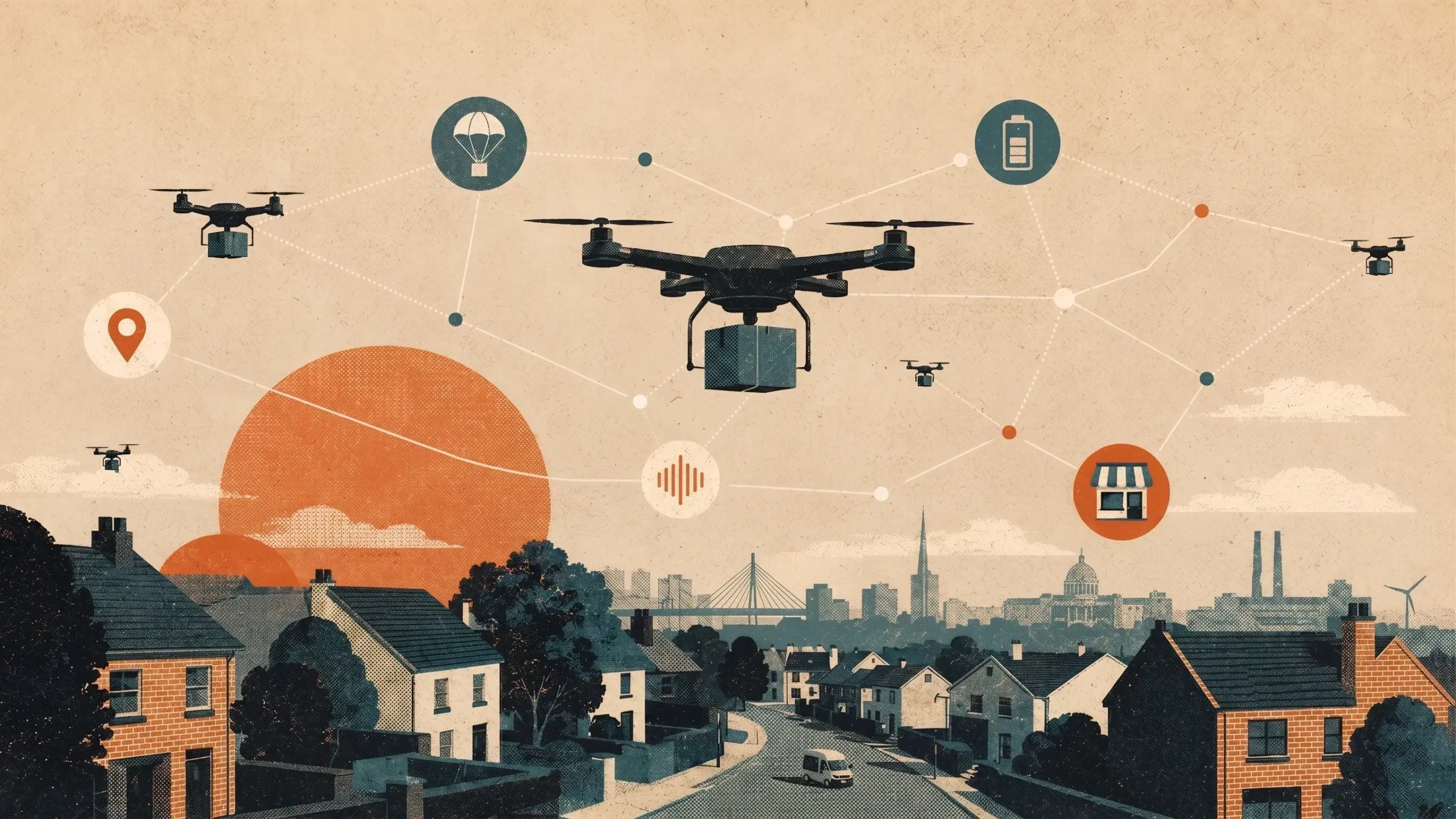
Bobby: There’s no explaining required. Kids know exactly what drone delivery is already. And so, I mean, put simply, you get our app, the Manna Drone Delivery app, you order your ice cream or your burgers and fries or your groceries, and you just tell us where on the map you want us to drop them. And then our aircraft, our drone will fly automatically to that area and it will drop the cargo off. It’ll hover over your house, your garden, whatever it is, and it will winched the product down to the ground and height about 20 meters. And that’s it. It’s magical flying robots to deliver ice cream and food.
Patrick: Wow. It’s interesting your answer because I would like it to revert. How would you explain to an eighty years old person? But, so I think it’s clear what you said so far and you found that, as I was saying when I was reading your bio you find that the manner drone delivery in 2018, in the same year “Wing,” for example, to become a subsidiary of Alphabet. But there are other companies like a “Drone Express” in Ohio or “Swoop Aero” based in Australia. And I also read about the some tests conducted by the German multinational “Delivery Hero” in 2020 with one of its subsidiaries “Foodpanda” with the project the “pandaFly.” So the question is why such a level of interest in this business?
Bobby: Yeah. I mean, it’s a huge space so that the space that we’re in is last mile delivery. So that’s delivery of everything from all small restaurants and small businesses to suburban houses. And today that’s about a 16 billion delivery business. In other words, there’s about 56 billion road deliveries a year.
Patrick: Wow!
Bobby: And that’s growing. It’s growing at about 20%. So that’s a market of over 100 billion, 150 billion actually dollars that we can get to. And anyone that gets into this space can get to. So it’s a very attractive industry. And then the other way to think about it is we produce zero CO2 when we fly. So we’re replacing the car on the road with a clean, electric robot that doesn’t produce any CO2. So from an environmental perspective and a safety perspective, it’s just far better. And so that’s kind of why it’s attractive. It’s economically a very big prize. It’s a huge industry and it’s better for the planet.
Patrick: Wow. Another question, what are the main challenges you see in this sector? So, for example, I was reading in one of your interviews that there might be a kind of software issue that needs to be solved in order to make the traffic fights easier and reduce the conflicts with other delivery drone companies does already exist a kind of consortium between the companies like Manna, Wing and so on? And again, what are the main challenges that you see now and in the future?
Bobby: Yeah, that’s a good question. So the technology, most of our business in our industry, it’s a software system at the hardware that the aircraft that flies, of course, has to be built. And it’s difficult. But the complex part of what we do is software. And so specifically what you would you mentioned we get asked a lot on it’s how do you guarantee that you’re not going to crash into your competitor’s aircraft or you’re not going to hit a helicopter that’s flying through your airspace, a police helicopter or ominous helicopter, whatever. And they’re systems that we’ve designed calledUnmanned traffic management systems (UTM). And we recently did a demonstration with Google’s drone delivery program Wing, where we flew at the same time in the same airspace, competing with each other, demonstrating that a big company like Google and a small company like Manna can share the airspace together safely using software. So Manna was the first in the world to do that. And it’s actually a surprisingly straightforward technological solution to that guarantees the safety in the airspace. So really, one of the biggest questions we get asked is, of course, around safety. And as it turns out, it’s not that difficult to do.
Patrick: Can I ask you, where have you run the test with Google here in Dublin or in U.S.?
Bobby: So both in Dallas, in Texas and in Dublin. So Google actually have a location. They recently announced it right here in Dublin, delivery, delivering medical equipment. And so you’ll see very soon in Dublin, both Manna and Google flying in the same airspace right here in Dublin and Dublin would be probably the leader or close to being the leader worldwide for drone delivery operations.
Patrick: Wow. So they are right when they were saying that is a kind of second Silicon Valley, the European Silicon Valley, Dublin. So it’s very interesting, even because I think you’re anticipated or you talked about something that anticipated my following question. What about the regulatory rules in Ireland, Europe in general and USA? Because maybe, I forgot to say, but Manna Drone delivery is also running its business in the USA. Hence, I think you have the experience in order to say what are the main differences between markets? If you have any knowledge even about, I don’t know, other markets like, I don’t know, India, Asia, Australia and so on.
Bobby: Very good question. And so the world is broken down into Europe, which is regulations are governed by the EASA, theEuropean Aviation Safety Agency, and in the United States, theFAA – Federal Aviation Administration.And so those two organizations dictate the regulations and therefore the law for doing what we do. And in the case of Europe. You know, the irony is often Europe does too much regulation, and that can be sometimes problematic for disruptive industries like ours. And but in this case, you need very strong regulation just to exist, just to be able to fly. You must have laws and regulations to allow you to fly in order to fly. Because in the end, there’s already people out there in 737’s and A320s that we need to consider. So regulations are a very good thing in our space. And Europe has been far ahead of the rest of the world in defining those regulations. And so we’re lucky to be able to say that we’re probably Manna is probably the most successful drone delivery business in the world because of not just our technology and how great we are, but because of strong regulation in Ireland initially, which is our home market and across Europe. So we’re in very strong position and probably ahead of the United States, the rest of the world like India, Latin America and so on, even in China is quite a bit further behind in defining the regulations, although there are many small companies starting to operate in those regions just without clear regulations and therefore going to be very, very difficult for those countries to scale anything safely, I think.
Patrick: Wow. Interesting. I have another question. At the moment, the Manna Drone Delivery is delivering mainly in the north area of the city. Is it a kind of a Beta Test? Is it part of a temporary permission or you are going to you are thinking to expand somewhere else around Dublin or Ireland and then how it is going to happen?
Bobby: Yes. So what many listeners will know is that we’re operating now in Dublin 15. We’re serving about 40,000 homes, about 150,000 people. And we will expand that operation within the Dublin 15 area and in the coming weeks. So it’s no longer really a trial. It’s kind of full production available to everybody that wants to use it. And we do plan then by the end of the year to be in a substantial part of Dublin of the commuter belt of Dublin around the M50. So I cannot name which suburbs yet, but for a very large Dublin suburbs we plan to be in this year.
Patrick: But, this is another question that just came out in my mind right now, because you need like a huge space that you can use like the headquarter of the base or that the decision to start the business somewhere else is based to some other reasons.
Bobby: No, we don’t need a large space at all. What we what we like is to put the aircraft beside our partner. The small business that we operate with, the small family restaurant or the big superstore grocery store, whatever. So we tend to put the aircraft where the product is and fly to the customers house from there. And we do have a new system that can fly from the central base out to the vendor to pick up the product and then on to the customer. But, that won’t be ready for at least another year. It takes a long time when you’re developing information to roll something out, but I think so for Dublin that means probably about 20 small bases with about 200 aircraft operating.
Patrick: Wow. 20 bases. And how many drones? You said again?
Bobby: About 200.
Patrick: 200? Wow. It’s a lot. And last question, before the music break, I heard the same complaints from people who live in the area where Manna Drone Delivery is operating. Do you have any updates about it? And the question inside the question, I also read in the FAQ section of the app that the total time of noise during the moment of the delivery is about 40 seconds. So …
Bobby: Yeah!
Patrick: At the moment your company is the only one, but what when other companies for example Google, as you are mentioning, will start operating. So what’s going to happen then about a /situation like this?
Bobby: Yeah, it’s a good question and a common one that we get. So, I mean, the way there’s a number of different components to the answer here. First of all, when the world kind of matures and there’s lots of drone delivery companies. Well, I don’t think there’ll be lots I think there’ll be a handful of good drone delivery companies. And that that just because there’s more companies doesn’t mean there’s more deliveries. The deliveries are a function of the consumption in the households that we serve. So, for example, in Dublin 15, maybe there’s is 2 or 300 flights a day, maybe there’s a thousand flights a day. But whatever the number is, those would be shared among the multiple companies because it’s the customers might be buying an Eddie Rockets or a Boojum or whatever, but so you don’t increase the number of customers for that, but the number of drone operators. That’s one component. The second one is we have in total 25 complaints out of 150,000 people operating after five months in Dublin 15. So they’re not insignificant and we take them very seriously. And one of the elements of that is around perceived issues with privacy. People just don’t want you flying over their house on the way to another every day. They assume or they think that there’s some cameras recording or something like that. And that’s kind of because up to now anyway, there’s been a lot of bad use of drones, you know, bad operators allowing them into airports. They’ve been spying on their neighbours, all these things. But we’re a highly regulated entity where we’re essentially a licensed airline and it would be completely against our license. We’d never be allowed to fly again if we did this, if we disagreed or if we didn’t obey those very strict rules around privacy. So there’s no data recorded that there’s no customer information. We don’t look at anything when we’re flying over people’s houses. We can’t see anything on five of people’s heads. So that’s generally the biggest reason for complaints. And then the other one is noise. And, you know, we get some complaints about noise or more. We get you know, we get questions of concern around what’s the noise going to be like? Is it going to be ruining my tranquil Sunday afternoon? And the truth is, it really isn’t. I mean, when people see our aircraft for the first time, they come out to our base and they see it. The first thing that they say is actually it’s not noisy at all. This isn’t going to be a problem when they see it firsthand. So again, there’s a perception problem that drones are noisy and for sure that the drones that most people will be used to, that you can buy in a in a consumer electronics retailer, and they have small propellers, they make a horrible noise. But then our drones, in light that they’re industrial grade drones, designed to be quiet, designed to be unobtrusive. And when we raise our so we’re in a trial mode now or we’ve been flying at 50 meters altitude, we bring that altitude up to 60 or 70 meters altitude quite soon. And that then will help again. We just it should be the point like it was in our previous operations where we had zero complaints and you really could not hear us when we were flying overhead.
MUSIC BREAK
Patrick: Thank you very much, Bobby. I would you like to talk about some technical aspects now of the market. Let’s say and the drone delivery and all that. Of this business, no? Is this a business that, as you’re saying, it’s huge and there is space for everybody. What’s the size of the drone fleet of Manna Drone Delivery at the moment and how big is a drone that is part of the fleet?
Bobby: Yeah. So we have less than 50 aircraft right now and in Dublin 15. We operate ten aircraft in total in the fleet. And how big is the drone? It’s quite big. It’s like you said when you were looking at the bus and you saw a huge white object in the sky about the size of a seagull with its wings open. So about 1.2 meters motor, two motor, so very large for a drone. But that’s because the cargo goes inside the aircraft.
Patrick: Wow. Technically, how does the delivery of an hamburger, let’s say, for example, no? So from where you based to our studios in Coolock for example, no? I mean from the moment that I order the hamburger via the app until when it arrives at the radio, what’s behind? How it works behind that?
Bobby: Yeah. So when you book on our app for our burger and so for example, Eddie Rockets are a partner of ours, we send the order to them, they cook the order, they prepare the order. Now we know exactly when the aircraft is going to take off. So we tell them probably about 11 minutes before the aircraft take off. We tell them to start preparing the burger because we know that’s how long it takes. They make the burger and then they bring it to us in a bag. That bag has a QR code on the bag and we, our staff take the bag, we weigh it, we scan the QR code to make sure it’s the right bag and we weigh it because it’s important that we know exactly the cargo waste that goes onto the aircraft. Then we load it in inside the aircraft. And the aircraft at that point already has its mission. It knows its coordinates for the delivery. It knows the speeds to fly out because it’ll change the flight speed depending on the altitude we’re flying to or from and depending on the wind speed in the wind direction. But so the aircraft will then take off and then it’s on its own. The aircraft flies itself completely. There’s no people involved in flying it, and it flies to the coordinates that you dropped us in the app. So we’ve given you a map of your house or your office, and you drop a little pin there saying where you want the product delivered. That pin to us is essentially a GPS coordinate, just like if you’re using Google Maps. The only difference is we fly in a straight line. We’ve no roads, we’ve no nothing to worry about. The traffic lights, things like that. We fly at 80 kilometres per hour as the crow flies. So our flights are about 3 minutes. And in Dublin 15, a little bit less, a little bit more sometimes, but roughly 3 minutes. And so your hamburger is very hot. It’s nearly as hot as it would have been if you ate it in the restaurant. And same for coffee. I mean, coffee is the number one thing we deliver. Like 30% of our deliveries are coffee and it arrives perfectly hot. So but the process is very I would say it looks very cool, but actually it’s we have such a big advantage because we fly like a bird in a straight line and in our case, 80 kilometres per hour. It’s an exceptionally cool way to get things.
Patrick: Wow. I think it’s interesting because there are a lot of things involved with. Like, I guess, like a kind of sync with the restaurant that is going to physically cook the order and then like the software that handles all the manage all the flight. Well, it’s very interesting. Anyway, talking with some friends about this interview that I would have had with you. And one of the most common questions I had so far, it wasn’t about software. It wasn’t about anything else. That’s just one question. Is it possible to deliver food for an apartment?
Bobby: It is, yes. So with apartments, we once we have the permission of the management company of the apartment, then they would allocate some communal delivery zones of apartments to areas of space that are safe in which we can deliver in for all of the residents of the apartment. BLOCK And that’s it. We just so if you if you live in an apartment, you order from us, we’ll deliver it there where the management company have made safe and clear area on which to deliver. And you get it the same way as if you had a back garden where we deliver it into it’s the same flight, it’s the same process. The only difference is, instead of walking out into your back garden to pick up the bag, you walk out to the communal delivery space.
Patrick: Okay. Because we would imagine eating, you know, getting a food there from my balcony, you know what I mean?
Bobby: So, I wish. I wish we can quickly. It is possible. Yes. And actually, those companies that have built that not competing ones, but ones that have built it for medical delivery, it is technically very doable, but it’s very it’s impossible to make it safe. And we are number one concern is safety. Everything we do thinks that safety. So even though technically it’s possible, it is impossible to make something like that really safe.
Patrick: While talking about to that, the company I read on the FAQ section of the app that the Manna Drones can deliver food that even during windy and rainy days the matter is it real? Are there are no limits for real? Or there is any level of alert to which drones cannot fly?
Bobby: There’s lot. So our drones can fly in 95% of Irish weather, which means, you know, means you can fly in most weather everywhere else. So the physics is you can’t lie about physics. And the hardest thing to do is wind. So rain is easy, snow is easy, and it’s impossible to fly in hail because the hail can damage the propeller. So we don’t fly in hail and we don’t fly in icing conditions. And the icing the icing does not mean very cold conditions like -20 Celsius. We can fly in, but I think conditions can be 0 to 2 or three degrees Celsius where there’s a combination of humidity, certain cold and certain barometric temperature that causes ice to build up very quickly on the wings and propeller, should I say. And that’s impossible to fly in. But ultimately, all of the barriers, including storms and things, the result is we can fly 95% of Irish weather, which means that we’re reliable, you know, available nearly all of the time.
Patrick: I read that Manna Drones fly at the height of 50, 65 meters from the soil and you have simulated the risk of drones falling. If so, what’s the worst case scenario?
Bobby: Yeah, we have. So the aircraft has a certain safety rating that’s approved by the regulator, the aviation regulator. And but it also has a parachute, a ballistic parachute on board. So, for example, if somebody you know, it’s not going to happen in Ireland, but if someone in America shot the aircraft, it’s going to deploy its parachute to land on the ground. Or if we had a complete battery failure, for example, which can happen, you know, not yeah. It doesn’t happen often. It’s never happened to us. Yes. But the law of large numbers says that everything that can fail will fail. And so in that case, we deploy a parachute and the parachute brings the aircraft safely to the ground without hurting anyone and the kinetic energy that the parachute incurs or generates or delivers when a hit, something is not sufficient to hurt anyone underneath. So it’s an extremely safe aircraft just on its own. And then there’s an extra degree of safety in the parachute. So I wouldn’t say it’s perfect. I mean, there’s no such thing as perfect. There’s always a potential of a safety incident. But we’ve certainly designed it in a way that it’s extremely safe. And I certainly wouldn’t hesitate to let the aircraft fly over my own children’s heads and to do deliveries. And we do think about that. It’s kind of it’s the number one thing that keeps this industry going slowly is to get it right, to get it perfect so that you can do a million deliveries a day or 10 million deliveries day and never going to hurt anybody. So that’s the system. It’s highly regulated, highly reliable, lots of redundancy built in, and then ultimately the parachute at the end of it all.
Patrick: Wow. It’s interesting. It’s also interesting about the risk you have in the US so that and I’m thinking about insurance coverage. But this is something we cannot talk about today because we only have 10 minutes left and I have some other questions that I would like to ask. So let’s imagine the future now. Do you think in that in a few years our skies will be full of drones?
Bobby: No, it’s funny. There was a Paw Patrol episode about five years ago where they had this dystopian world where the sky is full of drones. But it won’t be the case. The way it for people to think about this is in numbers. If you drive around Dublin 15 now or Tallaght or Glasnevin or wherever you know, Manna are going to be and look around at how many delivery drivers do you see? How many of those Deliveroo drivers you see? It’s actually not that many. You might be lucky to see one on your trip to the to the local convenience store or whatever. So it’s going to be the same for us. We’re just removing those drivers from the road and putting them in the air. So you’re not going to see many. It’s a function of how much or how many times people order in a very, very large area. So Dublin 15 is 30 square, nearly 40 square kilometres, and we might do between 200 to 2000 deliveries a day So it’s really never going to be the case that the sky would be full of dronesPatrick: Even because I think this one is a very expensive business because you have to buy, I guess, a drone somewhere and then there’s like a replacement things anyway. Do you think about this one is a question I put down about I think you already answered that because I was wondering if there is a some other company that is going to start delivering. And you were talking about a Google that is going to start sooner delivering like medical staff, if I remember well. Okay. Let’s go for another question. I have. I read in one of your previous interviews that the one of the benefits of delivering food via drone is better in terms of a lowering to the carbon footprint of deliveries. So if compared that with cars, for example, I also read that you are going to acquire green energy in order to compensate for the energy use of the for charging the battery of drones. And just a couple of just a couple of random questions right now, but may I ask you where you are going to buy green energy and if there is enough green energy for all the industries that want to acquire green energy in order to compensate for their energy, use it for their business. So what they mean is we are living in an era where everybody, everyone who wants to look at green friendly, inclusive and so on, but … Mathematically speaking, I think I’m not sure that that there’s enough for green energy for everybody at this stage. What do you think about that?
Bobby: Great question. And no, there is not enough green energy for everyone. And so right now our energy comes from the grid, just like any other electric operated like electric car or anything like that. But we do believe that in certain markets and but definitely the Irish market with wind energy and other markets would sell or in fact even with seller today, not Ireland but in other countries that that actually has sunshine. We could power all of our operations from solar or mounted off the roof of our operation, but we don’t do that today. But there is already a path to us being able to do that. When you look at Ireland and so, so way to think about energy, we use about 200 watt hours per flight, so about a fifth of kilowatt. And that translates to daytime rates of about five or six, maybe up to $0.10 of cost from electricity, Ireland or, you know, any of the providers. And so it’s a very low cost part of our operation. So it’s not the cost we would do this for. So if you sourced energy from a green provider, you can get it, but it might double your energy cost and that wouldn’t be a problem for us. And we want to do that and we will do that. So it’s where you cannot source green energy is in high, high demand operation. So for example, datacentres or even car charging, there’s just too much energy required and there is not enough green energy to go around. But for our industry there is because we use less it less electricity and then the electric bike uses to do the same journey. So for sure we could source green energy. We just haven’t yet, and we will. And stay tuned for our announcement on that.
Patrick: Thank you for your answer and even honesty. Last question. Do you think that delivering food via bike, for example, will still be a job opportunity in the future?
Bobby: Yeah, I don’t think it’ll destroy and I think it’ll, I think it’ll grow at massively. I mean one, one, one part of the current industry today is of course we have these Deliveroo or whatever they are drivers and bikers on the road doing essentially what’s a low paid job and a job in tough weather and a good job for particularly young people. And I think that’s great. And I certainly when I was young, I would have done that. I would have appreciated the job and I would have been happy to earn that wage. But I think there’s a better way to do things. And I think like any other disruptive technology is going to be a change in the way things are. I think in our case, those same people that are getting on electric bikes now or motorbikes and cars, you know, and rain in the dark in the winter. Yeah. To deliver a hamburger can come work for Manna or one of our many business partners. And to help us build that business, instead of carrying the burger around on the bike, it doesn’t make any sense. So I think we’re going to take the same people, I mean Manna have 120 people already in just one location. I think we’re a bigger employer than many of the delivery companies already that are in Dublin 15. I don’t think that there’s going to be any net destruction of jobs. I think there’s going to be creation of, I would say, better jobs, safer jobs, more enjoyable jobs and better paying jobs, I would say. So this is not an area, I think, but it is one we get asked about a lot. Patrick I mean, I frequently get asked. The robots are going to take away the jobs. A.I. is going to take away jobs. And I really don’t believe that’s the case for what we’re doing. And then the other thing to think about is, you know, if you just take one of our small vendors, Kahuna, Pops, Kahuna Pops is a small family run business at Dundrum. This is a husband and wife and they make ice pops out of ice cream. Homemade ice pops. Mm hmm. And we’re now supplying them to 150,000 people in Blanchardstown. And no doubt that is going to as we expand, that’s going to create jobs in that small business. So I think the fact that you can have delivery, that it’s so efficient, so affordable and so well received by the population, that it’s just going to grow. Consumption for domestic small business products everywhere we go and that will create jobs.
Patrick: Bobby I have a I think some other two hundreds questions, but unfortunately the time is over. So, Joe Bean is already ready for his radio show, Ska Patrol. That is going to start in a few minutes. I would like to say thank you very much for your availability today. Everything you shared with us before saying goodbye, I would like to ask you if you can tell us, for example, where we can find you online. If I remember where all of the websites would be manna.aero Is that correct?
Bobby: That’s right. That area lies in like airplane A-E-R-O manna.aero is the best place to find about it and to register your interest. If you would like to get drone delivery in your neighbourhood or at your house registered there. It’s fun. Follow me on Twitter. I always have all the freshest news on Twitter and videos of our operation, things like that. And please, I’d love to hear from everyone that’s listening whether your thoughts are good or bad or indifferent. I’m interested to hear so you can find me on LinkedIn. You can find me on Twitter and you can find me at our website. Send us a message. Let us know if you’re concerned. Let us know if you love us. And if you have a small business, a small family business, and you want to sell your products through Manna and have us deliver them to a million people in Dublin, let me know. We would love to have you on board.Patrick: Fantastico Bobby, I would like to say thank you very much once again for your interview and everything that you shared with us. And I would like to invite you once again for another interview, maybe when the company is going to be bigger or they’re going to start serving some other area. And because I am very interested about the technical challenges that there are behind that and the thanks for this interview. I think I learned a lot today. Thank you too much, Bobby.
Bobby: A pleasure, Patrick. Thanks for having me.
Patrick: Thank you very much.