
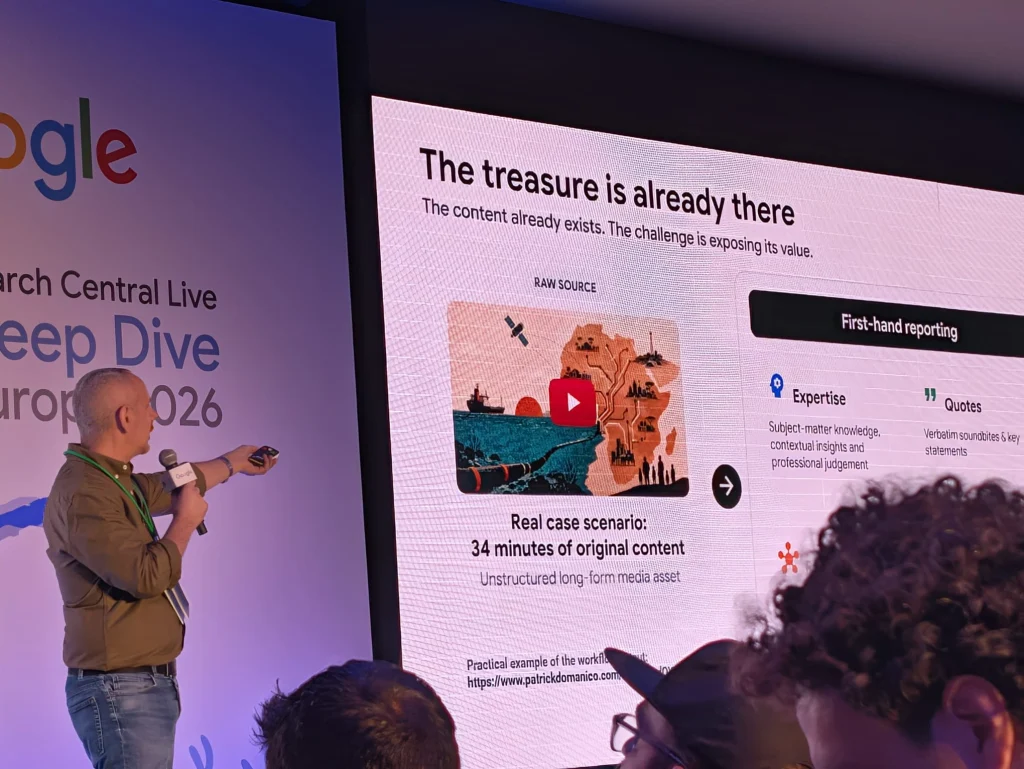
On 1 October 2026, I had the opportunity to present my idea of Prompt Journalism during the first European edition of Search Central Live Deep Dive organised by Google in Barcelona.
My lightning talk, “Prompt Journalism & Search: Making Interviews, Podcasts and Video Discoverable,” mixed two of my many passions, both particularly important to me: an ethical approach to journalism and Technical SEO (meant as Search Experience Optimisation).
The idea, originaly, came in my mind when I recently thought about a book I read a few years ago, Infoglut: How too much information is changing the way we think and know, written by Mark Andrejevic and published in 2013. One passage in particular: “before the advent of those device (referring to televisions, radios, computers, and so on), all we had to do was to go to the library to feel overwhelmed by more than we could possibly absorb.”
The author observes that information overload existed even before the arrival of modern communication technologies. And because I really love drawing parallels, it made me wondering about something a bit different.
Thus, the starting point was a simple question: how much valuable original content remains difficult to discover because it is locked inside interviews, podcasts, videos, live events, webinars and other long-form media that are not optimised for any kind of search experience?
Secondly, how can this type of content be organised in order to be absorbed, to continue referencing Andrejevic’s book, and avoid (I would add) any kind of FOMA (meant as Fear of Missing Anything)?
According to my direct experience (hence I can be 50% wrong), I have rarely seen a podcast/vodcast that, once released, was also optimised to be discovered by machines. Usually, this type of content is published online in formats that are difficult for Search to fully understand and for Users to fully access also missing basic concepts of Web Accessibility. For example, a short description, an embedded player, a video without a proper transcript, missing captions, or an article that does not clearly expose the sources, context, entities, and structure of the story.
At the same time, I am conscious of the fact that AI can be an opportunity, especially for content creators, freelance journalists and small-medium newsrooms, giving them more occasions of enhancement and competitiveness (because at the end of the day journalism is a business) as long as its use is ethical and deontological.
My talk at Google Search Central Live Deep Dive 2026 explored one of the aspects of what I really like calling Prompt Journalism and how prompt engineering can support the editorial, accessibility, and technical SEO processes, making clear that AI should not replace original reporting, expert knowledge, or editorial judgment.
Instead, prompt engineering can become part of a prompt-assisted workflow layer that helps creators organise their work, improve accessibility, support better technical SEO implementation, and make signals of Experience, Expertise, Authoritativeness, and Trustworthiness (E-E-A-T) easier to surface for both users and Search.
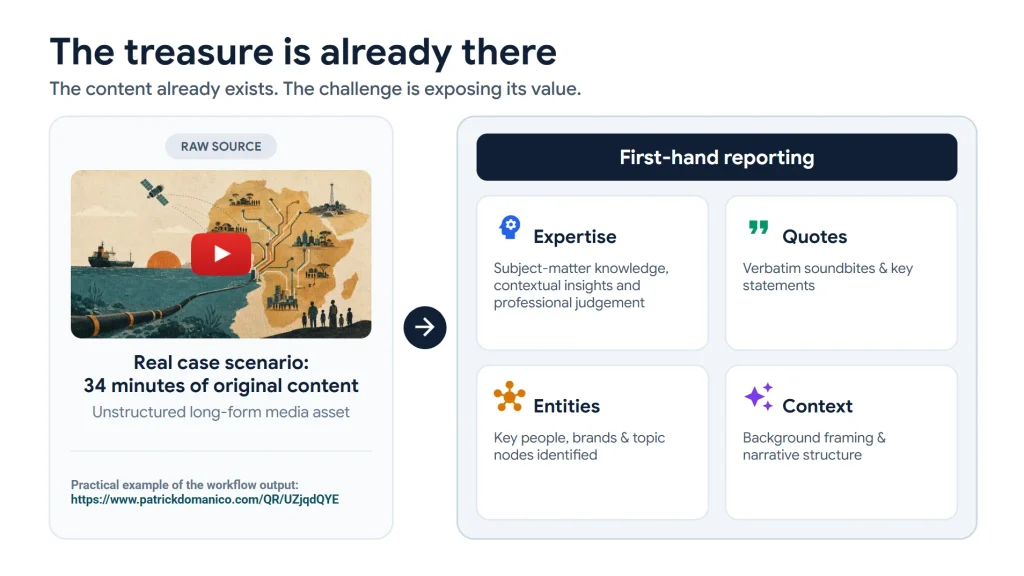
For the presentation, I used a real case scenario involving 34 minutes of original interview content. However, because this process is scalable, it can be applied and adapted to multimedia content of any length.
The treasure is already there
An interview can contain first-hand reporting, expertise, quotes, entities and context. The problem is not creating more content. The challenge is optimising it.
It is exposing the value that is already inside the source in a structured, reusable way.
Journalists and content creators regularly produce interviews, podcasts, video reports, webinars and long-form conversations containing pieces of information that may never be fully represented in their published articles. It may happens for many reasons. Maybe because of specific publishing requirements regarding the length of the article or the length of the multimedia file and so on.
During a 50-minute interview, for example, several subjects might be explored, not only the main topic of the interview. The interviewee might cite different people and projects, introduce different organisations and entities, contain valuable quotations and reveal connections that are difficult to capture in a single headline or short summary.
I truly believe that publishing the recording is valuable because it also brings full transparency to users. But the recording alone does not necessarily make all that information easy to navigate, access or interpret.
A listener may be interested in a particular statement. A researcher may want to identify the organisations mentioned. A journalist may be interested in a specific angle. A search engine may need additional textual and structural information, such as Structured Data, to fully understand the subject of a video. Someone else, instead, using assistive technology may require an accurate transcript.
This is where I see an opportunity for the application of Prompt Journalism. Instead of treating the interview as one piece of content to be rewritten repeatedly, the prompt-assisted workflow treats the interview as a primary source of evidence from which several verified editorial and technical outputs can be developed to increase the usefulness, accessibility and discoverability of original reporting.
The objective is to increase the usefulness, accessibility and discoverability of original reporting.
Why start with a transcript?
Although modern AI systems can process multimedia files directly, textual content is generally easier (and probably cheaper) for machines to analyse, structure, retrieve and reuse.
This is an important technical aspect that I personally consider when working with local, open-weight AI models. During my experiments, I found that processing a transcript was more manageable even on a laptop dating back to 2015, equipped with an Intel Core i5 processor, 8 GB of RAM and 128 GB of storage, running one of the most common Linux distributions, Ubuntu, with Ollama and Gemma 2 installed.
[Quick Tip: in one of my experiments to convert video or audio files into text, I used Pytranscript efficiently on different machines]Unlike text, audio and video typically require additional processing to extract spoken information, while a transcript makes that information available in a format that can be analysed by both traditional software installed locally and language models (LLMs).
This is why my prompt-assisted workflow starts with a transcript of the original recording. Rather than repeatedly processing the multimedia file for each publishing output, the transcript provides a common foundation from which information can be organised, analysed and transformed.
However, the original recording remains the primary source of evidence, as a transcript alone cannot fully represent aspects such as tone, emphasis, visual context or non-verbal communication.
Step 1: From raw transcript to verified semantic information
The first stage begins with the cleaning of the transcript.
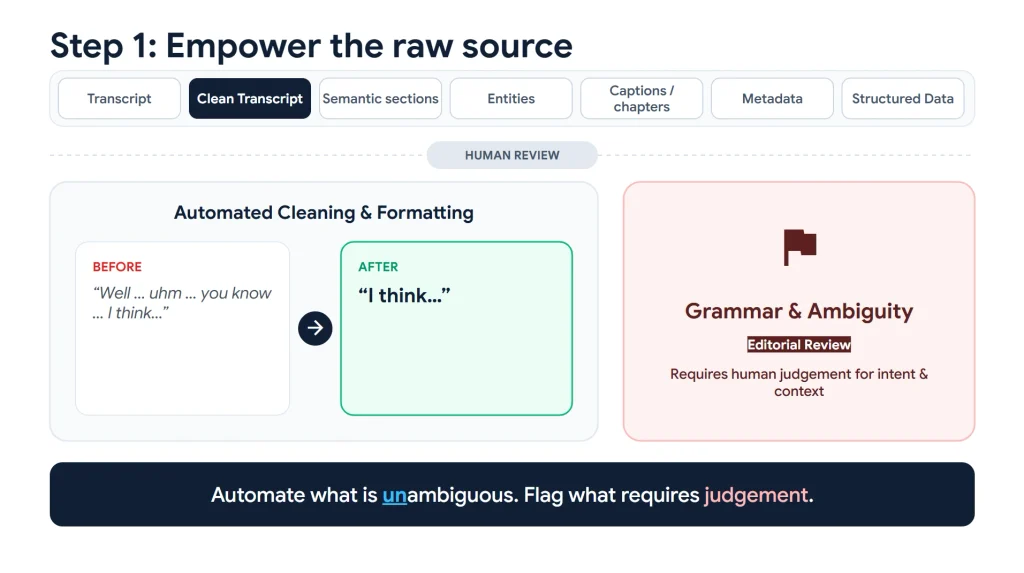
A raw transcript can contain filler words, hesitation, repetition, incomplete sentences, transcription mistakes and ambiguous passages. It may also lack speaker identification, meaningful sections and references to the people or organisations mentioned.
Prompt-assisted workflows can support several operations: formatting a transcript, suggesting semantic sections, identifying entities, proposing chapter boundaries and preparing information for metadata and structured data.
However, these activities do not all carry the same editorial risk.
Removing redundant whitespace or standardising formatting is relatively straightforward. Changing the wording of a statement, interpreting an ambiguous sentence or deciding what a speaker intended requires human judgement.
For that reason, one of the principles I presented in Barcelona was:
Automate what is unambiguous. Flag what requires judgement.
The original transcript should remain available as evidence, while any editorially cleaned version must be checked against the recording.
Editorial/SEO Judgement – Fidelity vs Compatibility
An interesting question emerges when preparing transcripts for publication: should spoken language be corrected?
This is an interesting aspect because, while the W3C, in its guide “Transcribing Audio to Text”, states in the section “Transcribe Accurately and Honestly” that “for most web content, it is acceptable to leave out non-substantive text to make the captions easier to process”, its guidance on transcribing audio and video also cautions that correcting grammatical mistakes is usually “not” appropriate”.
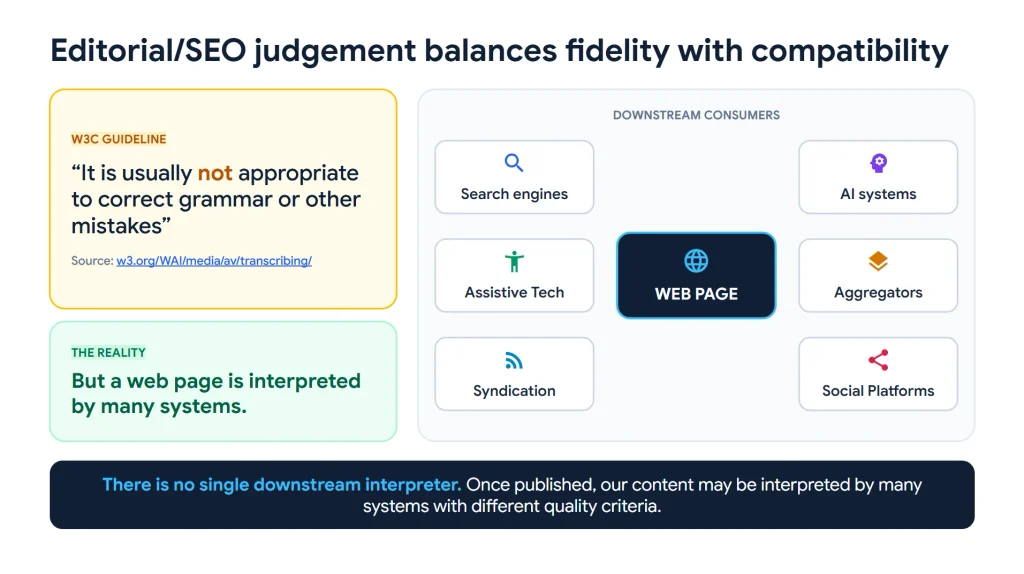
This is particularly relevant to journalism, where a quotation must accurately represent what someone said.
At the same time, thinking as an SEO, I am conscious of the fact that a published web page is consumed by different systems, each with its own requirements.
Search engines, AI systems, assistive technologies, aggregators, social platforms and syndication services may all interpret the same information differently.
For example, could a search engine interpret a few genuine grammatical mistakes as an indication of low-quality content, with potential ranking consequences? Google’s documentation, Creating Helpful, Reliable, People-First Content, encourage publishers to consider spelling and stylistic issues when assessing content quality. However, this does not necessarily mean that a few grammatical mistakes will affect rankings, and we do not know whether a specific threshold even exists.
Could the same apply to what is trending in the GEO / AEO / “WhatEOver” field at the time of writing this article: LLM citations? Could grammatical mistakes influence whether a source is selected or cited? Again, we don’t know how content is “judged” by algorithms and machines.
However, what about humans? How would you judge a written grammar mistake? Is it more acceptable if you hear some grammar mistakes rather than reading it? What are your expectations? What’s your genuine reaction if you read something like “I did understood”?
This is why, during my presentation on stage, I described this step as very important, as it requires balancing editorial judgement with technical compatibility.
In my opinion, the solution is not to rewrite an interview until it becomes more convenient for machines.
Rather, it is to preserve the original meaning and evidence while creating additional structures that improve readability, usability and machine interpretation.
One semantic map, many outputs
Once the transcript has been cleaned and reviewed, the prompt-assisted workflow brings us to the core of the process: mapping the content.
This is another very important step because it is at this stage that the model we have decided to use begins extracting and organising the different pieces of information contained in the transcript.
And this is where one of the most interesting opportunities for scalability emerges: transforming the extracted editorial information into a reusable semantic structure.
One of the most practical examples I presented concerned an interview section titled “Who owns the infrastructure?” by the model used for the demonstration.
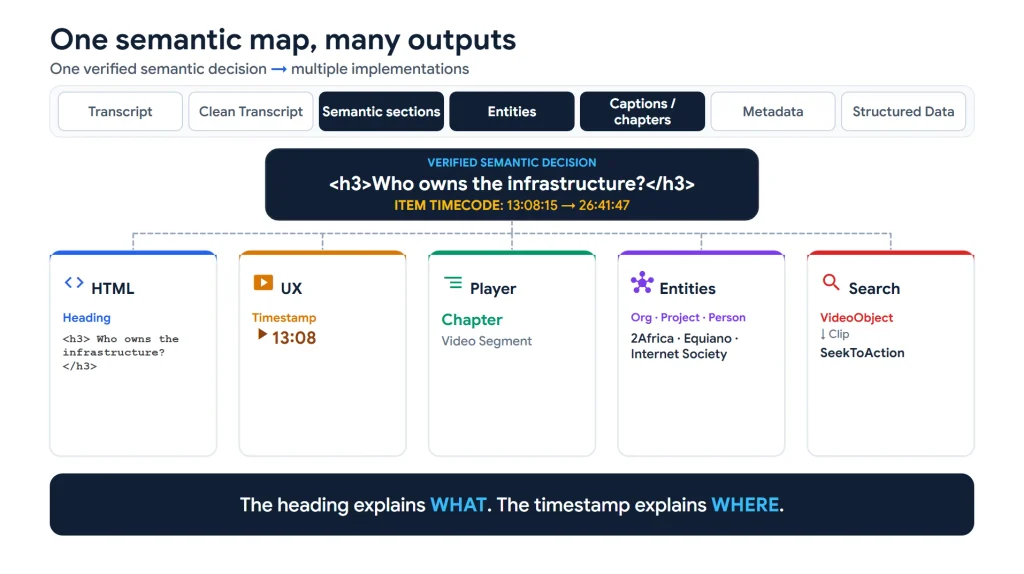
In the original recording, this topic was associated with a specific timecode and references to entities such as 2Africa, Equiano and the Internet Society.
Once the section had been identified and verified, the same editorial decision could support different implementations:
- The heading could become an HTML subheading (H2, H3, H4, etc.) within the article.
- The timestamp could help readers or listeners navigate directly to the relevant part of the recording.
- The topic could become a chapter in the media player.
- The associated entities could inform the article’s contextual information, which could also be useful for generating structured data and metadata, while the corresponding time boundaries could contribute to video-related structured data, where appropriate.
The important point is that these outputs should not be generated as disconnected interpretations. They should originate from the same verified semantic decision.
The heading explains what. The timestamp explains where.
This principle can help reduce inconsistencies between an article, its accompanying media and its machine-readable information.
It also creates opportunities for scalable technical implementation without requiring a journalist to repeat the same editorial analysis for every publishing format.
A useful workflow can therefore distinguish between:
- Original transcript:a faithful representation of the recorded speech.
- Reviewed transcript:a version checked for transcription accuracy, speaker identification and formatting.
- Semantic sections:meaningful divisions identifying the subjects discussed.
- Entities and context:identified people, organisations, projects and concepts, with their references verified.
- Captions and chapters:accessible and navigable representations aligned with the recording.
- Metadata and Structured Data (Schema.org):technical descriptions based on verified information.
These are related outputs, but they do not perform the same function.
Step two: Translate journalism into a prompt workflow
One of the most important opportunities for scalability, emerges when editorial information is organised into a reusable semantic structure.
Once the source material has been organised, the next challenge concerns the article itself.
This is where Prompt Journalism must remain journalism.
A transcript should not simply be submitted to an LLM (large language model) such as ChatGPT, Claude, Gemini, etc., with an instruction to produce an article. That approach gives the models too much freedom to select, interpret and potentially distort the material.
Instead, the workflow I proposed begins with an evidence map. And this is why the previous step is fundamental. The evidence map identifies supported facts, quotations, relevant entities and contextual material from the verified transcript.
Only after that the editorial process move towards identifying possible angles a long interview may contain more than one legitimate story. However, each story must be supported by evidence.
For each selected angle, the workflow can retrieve the supporting passages, preserve attribution and organise the information using established journalistic techniques.
Implementation of the inverted pyramid
Inverted pyramid style articles follow one of the oldest formulas of the so-called hard news used in newsrooms, placing the most newsworthy information at the beginning, followed by key facts, attribution, supporting context and secondary details.
Due to its formulaic nature, prompts can help organise the inverted pyramid process, enforce evidence requirements and prepare drafts for editorial review.
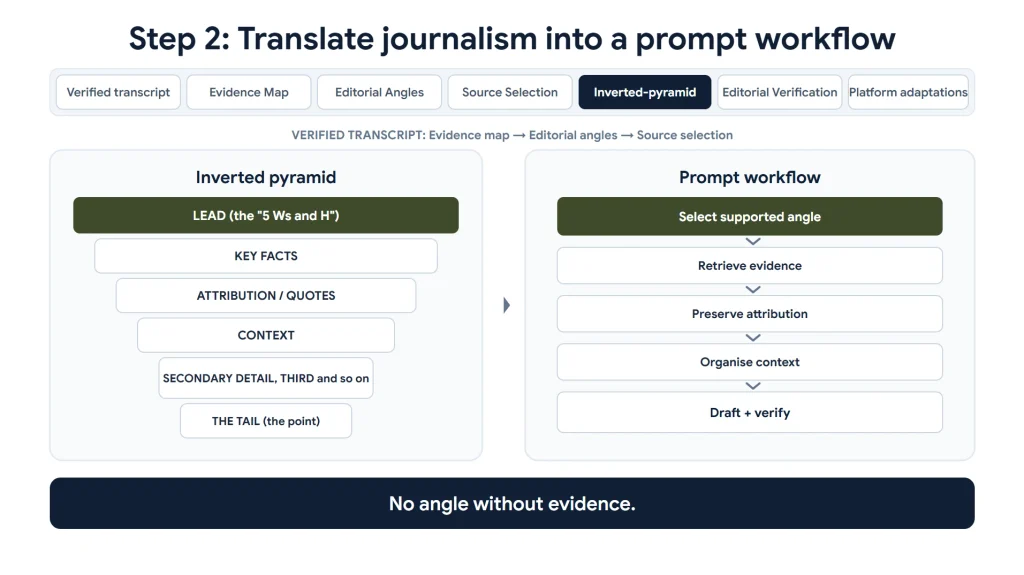
LLMs should not autonomously decide which interpretation of the interview is true, invent supporting context or turn a weak statement into a stronger claim.
Journalists and content creators remain responsible for selecting the angle, checking the evidence, evaluating the context and approving the final article.
One source, different publishing contexts
After the original source has been verified and an editorial angle established, the content can be adapted for different publishing environments.
In my presentation, I depicted five outputs, but they can be more:
- The full article may be published on the publisher’s website, accompanied by relevant internal links, related reporting, timestamps and appropriate structured data.
- A LinkedIn post might focus on one particularly interesting finding and direct readers to the original publication.
- A Substack/newsletter style could introduce additional context and explain why a particular aspect of the interview matters to its audience.
- X might be more appropriate for a short quotation.
- YouTube might be more appropriate for an informative video segment or a list of the most important takeaways.
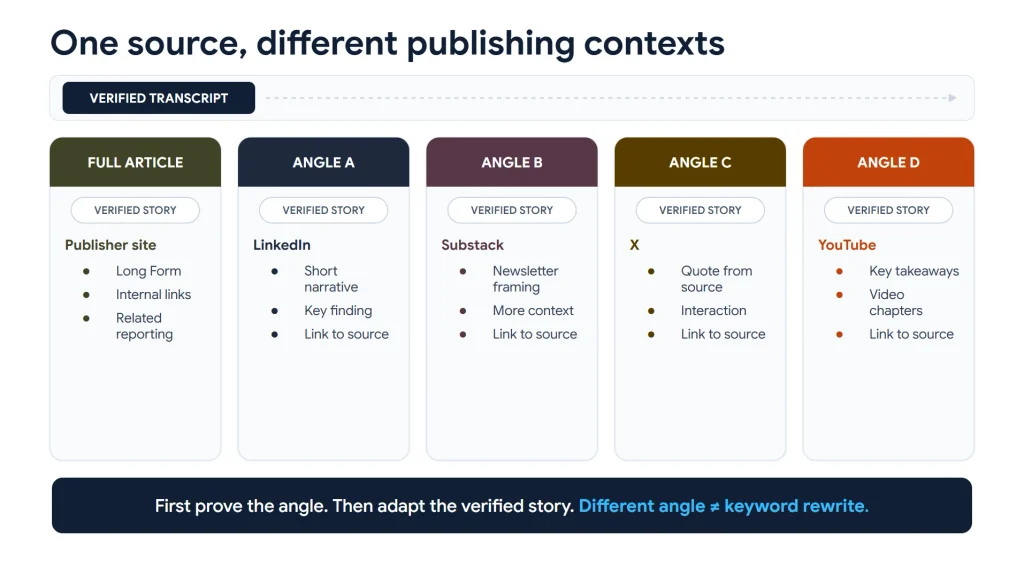
These are not necessarily different versions of the same article.
A single interview may support several different editorial angles, as long as each one can be traced back to evidence. At the same time, one verified story may require different formats depending on the platform where it is published.
The distinction is important because different editorial angle is not a keyword rewrite.
Scalability should not become an excuse for producing dozens of nearly identical articles designed primarily to occupy search results.
Instead, the purpose is to make original journalism more useful in the environments where different audiences encounter it.
Prompt-assisted, not prompt-decided
Personally I believe that the fundamental value of this approach is not the number of articles, social posts or metadata fields that can be generated.
It is the possibility of building a repeatable editorial process that maintains a connection with its original evidence. I truly believe that never before, as much as at this moment, has a website (the original source) been so important as the place where the content journey starts and ends its life cycle, and social platforms play an important role in this journey.
- The verified transcript, primary evidence map and fact-checked context form the foundation.
- Human editorial intent defines which stories deserve attention.
- Structured prompts assist with retrieving evidence, organising information and adapting verified material to different publishing requirements.
- Human verification provides the necessary editorial control before publication.
- Finally, the outputs can include complete articles, newsletters, social content, navigable transcripts, video chapters, timestamps and structured data.
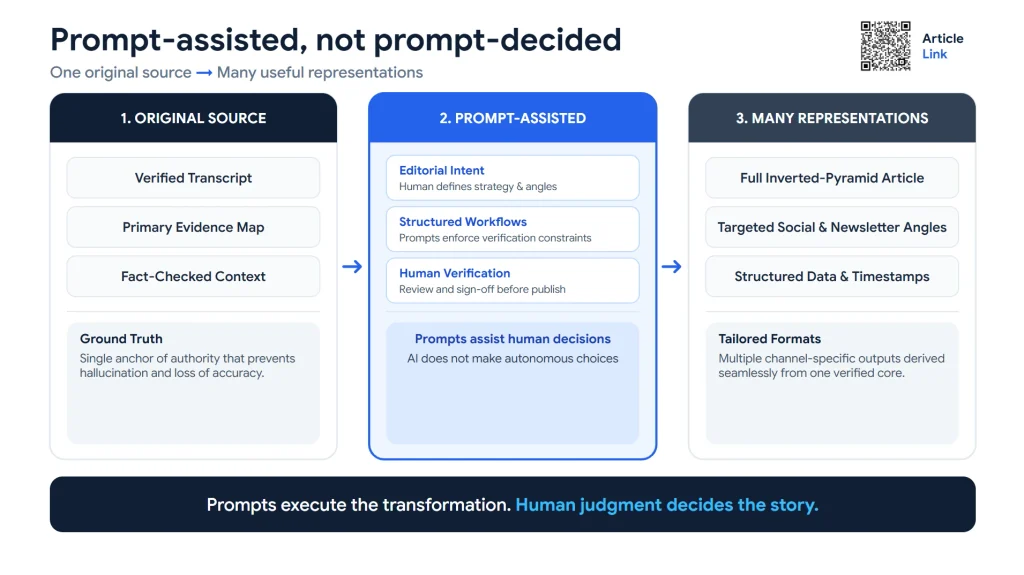
It is a workflow designed to improve discoverability for people and machines, without making either more important than accuracy, attribution and editorial responsibility.
The approach is also a reminder that artificial intelligence does not have to replace journalism to become useful within journalism.
In many cases, the original reporting has already been completed. What we need are better ways to organise it, verify it, preserve it and make it accessible.
That is the idea I wanted to share in Barcelona.
Never fotget: Prompts execute the transformation. Human judgement decides the story.
REFERENCES
- Prommawin, Cherry, and Gary Illyes. “Search Central Live Deep Dive Europe 2026: Meet the Community Speakers.”Google Search Central Blog, 16 September 2026.. Accessed 11 October 2026.
- Kim, Ye Jin. “Prompt Engineering as a Fundamental Competence in the Creation of Journalistic Content.”Global Digital Culture & Communication, vol. 3, article 14, 30 January 2026.https://doi.org/10.65835/gdcc.2026.3.14. Accessed 11 October 2026.
- Andrejevic, Mark. Infoglut: How Too Much Information Is Changing the Way We Think and Know. Routledge, 2013.
- arnaud-ma. “Pytranscript.” Version 0.3.0, Python Package Index (PyPI), 11 November 2024. Accessed 11 October 2026.
- World Wide Web Consortium (W3C). “Transcribing Audio to Text.”Web Accessibility Initiative (WAI), first published September 2019, updated 24 November 2020. Accessed 11 October 2026.
- Google Search Central. “Creating Helpful, Reliable, People-First Content.”Google Search Central Documentation, Google, last updated 5 October 2026. Accessed 11 October 2026.
- Po¨ttker, Horst. 2003. “News and Its Communicative Quality: The Inverted Pyramid—When and Why Did It Appear?”Journalism Studies4 (4): 501–11.https://doi:10.1080/1461670032000136596. Accessed 11 October 2026.