


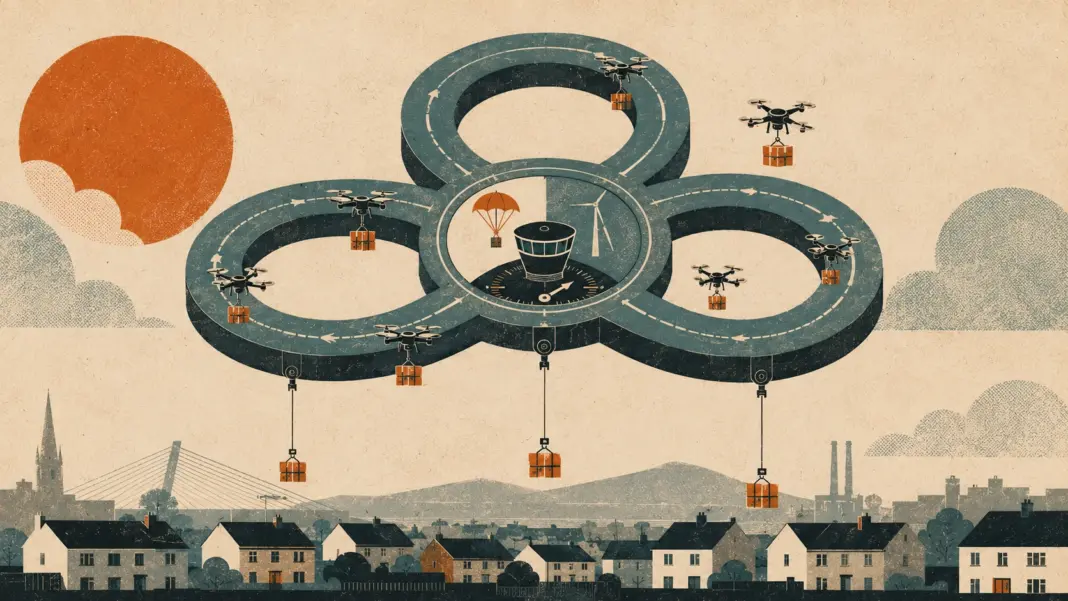
In a recent interview, Bobby Healy shared insights about the company’s journey, challenges, and future.
How Manna Drone Delivery works
Manna’s mission is clear: to make deliveries fast, eco-friendly, and reliable. Healy explains the concept with simplicity: “You use our app, order your ice cream, groceries, or meals, and pin your delivery spot on a map. Our drone flies to the location, hovers about 20 meters above the ground, and winches the package down. It’s like having magical flying robots delivering your food.”
Operating in Dublin’s northside, specifically in the Dublin 15 area, Manna currently serves 40,000 homes, reaching about 150,000 people. Plans to expand into other parts of the city’s commuter belt are already underway, with a goal to establish 20 small operational bases and deploy 200 drones across Dublin.
Safety First
Safety is at the heart of Manna’s operations. With drones flying at altitudes between 50 and 65 meters, Healy acknowledges that potential risks require meticulous planning. “Our aircraft are equipped with a ballistic parachute,” he notes. “If there’s a battery failure or another issue, the parachute ensures a safe landing with minimal risk to people on the ground.”
Manna has also been proactive in addressing airspace safety. In collaboration with Google’s drone delivery program Wing, the company successfully demonstrated the ability for multiple operators to share airspace safely. “We flew in the same airspace, proving that even a small company like Manna and a giant like Google can coexist safely with the right software,” Healy shared.
Regulatory Landscape
Navigating regulatory frameworks is one of the biggest challenges for the drone delivery industry. Europe, governed by the European Aviation Safety Agency (EASA), is leading the way in establishing clear guidelines. “Regulations are crucial in our space,” Healy emphasized. “Without them, scaling safely is impossible.”
Ireland, in particular, has been at the forefront of enabling drone delivery operations. This progressive regulatory environment has allowed Manna to thrive. By contrast, regions like Latin America and India lack the regulatory clarity needed for large-scale operations.
Addressing Concerns
Public perception is another hurdle. Privacy and noise are common concerns. Healy was upfront about these challenges: “We’ve had 25 complaints out of 150,000 people over five months in Dublin 15. Most relate to privacy and noise. However, our drones don’t record data, and they’re designed to be as quiet as possible. Increasing flight altitude to 60 or 70 meters will further reduce noise.”
The Green Energy Gap
A major selling point of drone delivery is its potential to cut carbon emissions by replacing road vehicles. Yet, as Healy admitted, Manna currently relies on grid electricity, which isn’t fully green. “There’s not enough green energy for everyone,” he explained. “But Ireland’s wind energy and solar opportunities in other markets give us a path to sustainability.”
Energy consumption per flight is minimal—about 200 watt-hours, or roughly $0.10 in electricity costs. While Manna plans to transition to renewable energy, the global shortfall of green energy remains a broader challenge.
Creating Jobs, Not Taking Them
One of the common misconceptions about drone delivery is that it will eliminate jobs. Healy strongly disagrees. “Disruptive technologies change industries, but they don’t destroy jobs,” he said. “We’ve already created 120 jobs in one location. Many of these roles are better, safer, and more enjoyable than traditional delivery jobs.”
Manna’s operations also boost local businesses. For example, Kahuna Pops, a small family-run business in Dundrum, now serves 150,000 people in Blanchardstown thanks to Manna’s delivery platform. “Affordable and efficient delivery systems drive consumption for small businesses, creating more jobs and opportunities,” Healy said.
Looking Ahead
Will our skies be filled with drones? Healy dismisses this dystopian vision. “You’re not going to see skies crowded with drones,” he assured. “We’re replacing delivery drivers with drones. In Dublin 15, for example, we’ll have between 200 and 2,000 flights a day, spread across nearly 40 square kilometers. It’s a manageable number.”
Despite the challenges, Manna’s future looks bright. Combining cutting-edge technology with a focus on safety and sustainability, the company is paving the way for a new era of logistics. As Healy summed up, “It’s an exceptionally cool way to get things.”


