
The foundational technology for a decentralized internet is already here. Today, the biggest challenge facing the Web3 movement is no longer building the infrastructure, but convincing the public to actually use it.
Speaking at the recent Web3 Summit, Bill Laboon, Vice President of Technical Operations at the Web3 Foundation, emphasized that the industry’s main obstacle has shifted from technical development to user adoption and education. While acknowledging that Web3 has become far more user-friendly, Laboon noted that the present difficulty is making people understand why privacy-preserving alternatives to everyday centralized apps are necessary.
The Two Sides of Digital Freedom
At the core of this push for adoption is the concept of “digital freedom.” According to Laboon, everyday applications like WhatsApp, Facebook, and even Signal are controlled by centralized entities that can extract valuable metadata, mapping out users’ daily routines.
Digital freedom, Laboon explained, exists in two parts:
- Negative Freedom: The right to be left alone, allowing users to communicate and interact without third-party surveillance or data harvesting.
- Positive Freedom: The ability to express oneself digitally and run desired code without interference from a central authority or government.
“A big myth is just that we have to give up on this,” Laboon stated, pushing back against the idea that a world dominated by major tech companies is unavoidable.
Blockchain as a Counterweight to AI
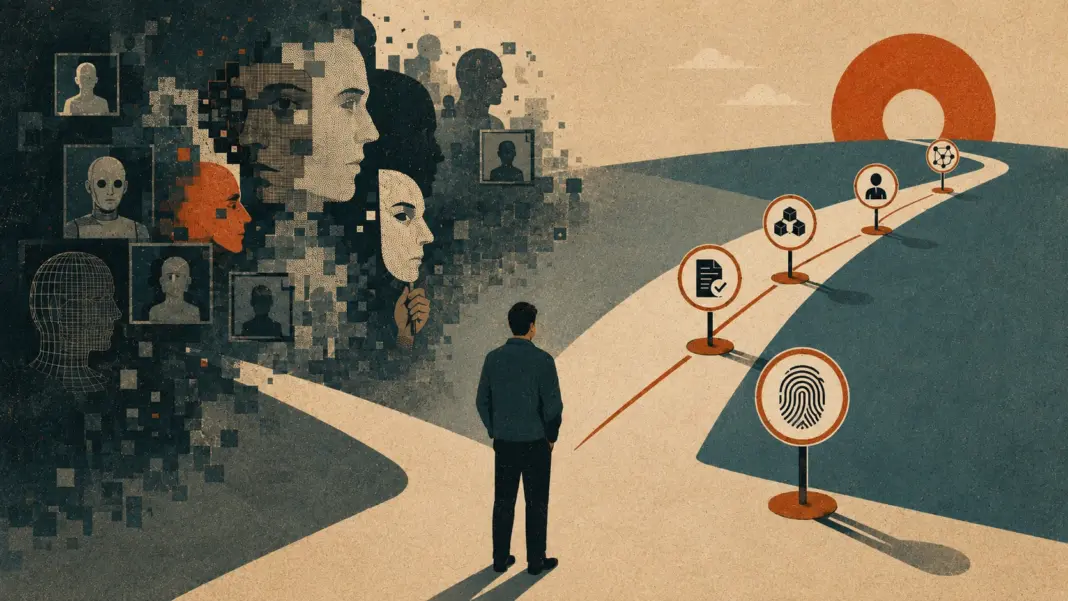
As artificial intelligence rapidly accelerates and the creation of deepfakes becomes trivial, Laboon positions blockchain as a critical tool for establishing truth.
“Blockchain is all about truth and AI is the opposite,” Laboon said citinh a common joke. He highlighted that blockchain can provide “proof of personhood” to verify human users against bots, and ensure content authenticity. For journalists and creators, this means the ability to cryptographically prove that a photograph or video was taken by a specific device at a specific time, offering an unfalsifiable defense against AI-generated hallucinations and a streamlined way to protect copyright.
The Regulatory Bottleneck and the Linux Parallel
Looking five years into the future, Laboon expects the primary bottleneck will be regulatory discussions across governments.
When the conversation drew a comparison to the historic trajectory of Linux, Laboon embraced the parallel. Just as early Linux was often dismissed as a niche tool for command-line enthusiasts, early blockchain faced stereotypes ranging from underground markets to speculative “crypto bros.” Today, Linux powers most global servers and Android phones behind the scenes. Web3 is reaching a similar milestone: applications featured at the summit mirror standard Web2 interfaces, entirely hiding the blockchain mechanisms underneath.
Yet Laboon noted an important distinction: unlike Linux, where the end user never needs to think about the operating system, it is important from a societal perspective that users recognize when and why they are using decentralized tools to protect their personal data.
Quantum Computing: The Next Y2K
Quantum computing is another challenge, but Laboon does not see it as something that will simply destroy blockchain.
Drawing on his experience working on software ahead of the Y2K millennium bug, he compared the two problems.
The threat is real, he argued, but engineers know it is coming and quantum-resistant cryptography already exists. The bigger question is how to coordinate the transition.
Bitcoin could be one of the more complicated cases.
Laboon said a significant amount of Bitcoin remains in addresses that would need to migrate to quantum-resistant cryptography. That raises a difficult question: what happens to coins whose owners never move them?
He also raised a hypothetical problem around Bitcoin’s ten-minute block time. If a future quantum computer were able to derive a private key from a public key in around five minutes, he argued, that could create a window in which an attacker might act before the next block.
The issue, in other words, is not only technical. It is also about getting a decentralized community to agree on what to do.
A Web3 Coordinator
Despite these challenges, the Web3 Foundation is deliberately stepping back from direct intervention. As networks like Polkadot mature, Laboon noted that his role and the Foundation’s mandate have shifted away from top-down direction toward resolving roadblocks and fostering community communication—operating as a “coordinator rather than a commander.”
Ultimately, transitioning to self-sovereign systems requires users to accept greater personal responsibility over their digital lives. When asked what single step users should take today, Laboon offered straightforward advice:
“Read the terms and conditions. When that little cookie pops up… just one time, read it and see where all your data is going,” Laboon urged. “It really is eye-opening.”